





A new report from the Center for American Progress Action Fund shows just how much Texans stand to benefit from Obamacare. Though some members of Congress are yet again pushing to repeal the nation’s health law, the law will help reduce the number of uninsured people and prevent insurance companies from denying care to people with pre-existing conditions, along with lots of other benefits.
Soon, more Texans will be covered.
Among the report’s findings, as our friends at Progress Texas have noted, 22 of the 30 counties nationwide that will benefit most from the Affordable Care Act are here in Texas. The 30 counties were selected because they had some of the highest rates of uninsured people and some of the worst health-related outcomes. A Texas Tribune report on the study mentions that about 40 percent of Texas’ uninsured, more than 1 million people, are expected to receive coverage next year through the health insurance marketplace. Most will get tax credits to help them pay for that coverage, too.
Phillip Martin from Progress Texas says each of the 22 Texas counties that will benefit the most have a population over 25,000:
Burnet ♦ Cameron ♦ Cherokee ♦ Cooke ♦ Dallas ♦ Ector ♦ El Paso
Henderson ♦ Hidalgo ♦ Hopkins ♦ Kerr ♦ Matagorda ♦ Maverick ♦ Navarro
Polk ♦ Potter ♦ Starr ♦ Titus ♦ Val Verde ♦ Waller ♦ Webb ♦ Wharton
Today, the House of Representatives is expected to vote for the 40th time to repeal the Affordable Care Act. But this is no time to refight old political battles. We need to look forward and focus on helping Texans get the coverage they need.
Written By: Laura Brubaker, Engage Texas
Texan Sally Jo Hahn is self-employed and has a history of health concerns. Finding coverage on the private insurance market has been nearly impossible. Even the state’s high-risk pool, which would have cost thousands of dollars, kept her from joining for a time.
Under the Affordable Care Act Sally Jo’s choices—and those of many other Americans—will improve greatly.
Sally Jo of Austin Credit: Austin American-Statesman
Much of the American Dream is based on our country’s historic facilitation of self-made individuals who work hard to establish their own businesses and pave their own way. Our openness to self-started businesses is something that Americans are not only known for but intensely proud of.
Self-employment offers opportunity for unique entrepreneurship and the optimal utilization of individuals’ experience. It also serves as an avenue for increased job creation. But changing jobs—finding the right fit in a position that aligns with one’s interests—is another vital piece of any dynamic economy. People need to be able to go out and do what they’re made to do.
Today, however, Americans are often deterred from starting their own businesses or changing jobs, for fear of losing the security that comes with the job they have. Concern over being denied insurance coverage because of pre-existing conditions, being charged higher premiums, or losing access to a trusted provider keeps workers in “job lock,” continuing to work in jobs they would otherwise leave—in order to maintain health coverage.
As we’ve noted before, research from the Urban Institute and Georgetown University shows health care reform can help alleviate job lock and is likely to lead to 124,000 Texans striking out on their own. Beginning in 2014, no applicant for non-group coverage may be turned down for assessed risk or health status. All health insurance policies must provide a minimum level of coverage that includes 10 Essential Health Benefits, mandating coverage in areas such as maternity and newborn care, mental health, pediatric care, and general preventative, wellness services.
New reform under the ACA offers Texans and many other Americans the opportunity to venture out on their own and try something new. Workers will now feel more secure starting new endeavors that cater to their unique skillsets and experience, without the worry and concern that they cannot access quality, affordable health care for themselves and their families.
Written by: Hannah Guernsey, Children’s Defense Fund - Texas
News out this week provides more evidence that, with coverage, children do better. They have access to care, get timely and appropriate treatment and shield their families from financial distress. When children’s parents also have coverage, research shows these benefits are reinforced and strengthened. That’s why the new health insurance marketplaces available to all Texans are so important. Children’s and families’ long-term health and success are at stake.
But what is this new marketplace? And how will it help a family get coverage?
Ever been to a website like Kayak or Travelocity? Notice how easy it was to customize exactly what you were looking for and compare cheap plane fares side by side for your convenience? No, I’m not trying to sell you airline tickets. I just find this is the best way to convince people how easy and transparent it is going to be to buy health insurance less than 100 days from now. That’s because, despite Texas’ best efforts, federal health reform is being rolled out right now.

For many low- to middle-income individuals and families, affordable, robust health coverage will be available to purchase October 1st in a brand new health insurance marketplace online. In fact, Healthcare.gov or CuidadoDeSalud.gov, the federally constructed website is live right now to show families what options will be available in three months. After answering a few questions about yourself and what you are looking for your options will be customized for you with a handy checklist to get you ready for October. Prefer not to shop online? No problem. Health insurance navigators will be available in person or over the phone to help you choose what plan is right for you.
Certain individuals and families will even have access to subsidies to help them with their health insurance premiums. These premium tax credits can either be used to lower the cost of your monthly premiums or be collected as a lump sum come tax time. A family of four could earn up to approximately $98,000 a year and still qualify. Not only will your new health insurance be affordable, but it will be guaranteed to offer a basic foundation of coverage so you no longer have to purchase additional add-ons for essential care like maternity care or mental health and substance abuse services.
Many organizations are reaching out to Texans and could use volunteers to keep the conversation going right up until October 1st. Enroll America’s Get Covered Texas campaign is hosting local events in many communities across the state. Texas Well and Healthy will continue to shareinformation on this new enrollment-focused resource page as it becomes available, giving you great opportunities to share with those in your community.
So spread the word! Recent polls suggest that nearly 4 in 10 Americans are unaware the Affordable Care Act still stands, and 80% of eligible Americans don’t know about their new health insurance options. With more than 1 in 5 Texans uninsured you are bound to know someone who could benefit from the information at Healthcare.gov.
Written by: Clayton Travis, Texans Care for Children

Houston Canvass
9AM
Good Neighbors Healthcare Clinic
190 Heights Blvd.
Houston, TX 77007
Dallas Canvass
9AM
True Lee Baptist Church
3907 Bertrand Ave
Dallas, TX 75210
Austin Press Conference
10AM
City Hall Plaza
301 W. 2nd Street
Luckily, the word “affordable” in The Affordable Care Act isn’t just for show. The law provides unprecedented access to reasonably priced health coverage for millions of Americans and cost controls to boot.
For example:
- Many who are uninsured will be eligible for federal subsidies to help them purchase coverage through the online marketplace that’s sometimes called a health insurance exchange. In fact, up to 2.6 million Texans could get help buying insurance with these new health care tax credits.
- Giving more small businesses and individuals the opportunity to participate in the marketplace will drive prices down thanks to our good friend “supply and demand.”
- By investing in wellness initiatives, the ACA can help minimize expensive treatments for chronic illnesses farther down the road.
Another beneficial change involves experiments with paying for care based on health outcomes. Right now, providers have incentives to have their patients make more office visits, get more tests, and have more procedures, because each of these things gets paid for separately. Health reform experiments instead with creating incentives based on how patients fare with the treatment they’re given. This “quality over quantity” approach has the potential to get rid of wasteful and potentially dangerous over-testing and to improve healthcare overall.
Thanks to the law, insurance companies face limits on how much they can raise rates and what they can use to decide pricing. As of 2014, health insurance providers will be able to charge based on only the following factors:
- Scope of coverage
- Geography
- Tobacco use
- Wellness program participation
- Age
Contrarily, insurance companies will be prohibited from considering any of these things in their prices:
- Gender
- Health status (pre-existing conditions!)
- Occupation
- Genetic information
- Claims history
It’s progress! All in all, the ACA will include prevention measures, improve healthcare quality, and promote competition within the health insurance marketplace to help keep down costs. That is one reason the law is projected to decrease the federal deficit by $143 billion in its first decade. Making health insurance increasingly affordable while decreasing the deficit—pretty reasonable, don’t you think?
Written by Anna Sanderson, Intern for Children’s Defense Fund - Texas
Three of four people who will be eligible for coverage through the new online health insurance marketplace opening in October say they want in-person assistance to help them learn about and enroll in coverage. Navigators—in-person assistance providers who will help consumers and small employers enrolling in the marketplace—are one of the ways the Affordable Care Act addresses this demand. Navigators will also be able to tailor outreach efforts to marketplace enrollees who, compared to people who are insured today, are more likely to be lower income, less educated, more racially and ethnically diverse, and more likely to speak a language other than English.
Today, the U.S. Department of Health and Human Services released its Funding Opportunity Announcement (FOA) for ACA Navigators in federally facilitated or state partnership exchanges. U.S. HHS encourages all applicants to submit a letter of intent (optional) by May 1, 2013 to [email protected]. Final applications are due by 1 p.m. (EDT) on June 7, 2013 through grants.gov. Awards will cover a 12-month period of performance following the anticipated August 15, 2013 award date.
The total $54 million award will be distributed among the 34 eligible states according to a formula that directs more funding to states with larger uninsured populations, with $8,151,185 earmarked for Texas. At least two types of eligible entities will receive awards in each state, including at least one community and consumer-focused nonprofit.
You can find the full grant announcement on www.grants.gov by searching for CFDA 93.750.
Applicants must have an Employer Identification Number/Taxpayer Identification Number (EIN/TIN) as well as a Dun and Bradstreet Data Universal Numbering System (DUNS) number, and must register for the System for Award Management (SAM) database in order to apply. Completing these steps can take up to four weeks. More information can be found at the grants.gov page, “Get Registered.”
U.S. HHS will host two technical assistance calls in upcoming weeks for organizations interested in applying:
First call: Thursday, April 11, 2013 from 3:30 to 5:00 p.m. EDT
Toll-free teleconference phone number: 877-267-1577; ID: 5119
Second call: Friday, April 19, 2013 from 3:30 to 5:00 p.m. EDT
Toll-free teleconference phone number: 877-267-1577; ID: 2917
U.S. HHS also released a rule last week that proposes the training, conflict of interest, and privacy/security standards that will apply to Navigators. Comments on the rule are due by 5 p.m. on May 6, 2013.
Written by: Stacey Pogue, Center for Public Policy Priorities
If you’re an entrepreneur or small business owner, plan to become one, or work for one, there are 2 webinars (online presentations) coming up on March 12 and March 15 that WILL benefit you and your business.
The Texas Well and Healthy Campaign has partnered with the Small Business Majority to make these presentations available. Obviously, you’re already familiar with our grassroots Texas Well and Healthy campaign dedicated to ensuring access to quality, affordable health care for all Texans. For those who don’t know the Small Business Majority, it is a national non-profit group working to support America’s 28 million small businesses.
The 2 webinars will address what the new healthcare law — the Affordable Care Act — means for Texas small businesses. The presentations will focus on both federal and state provisions to help local small business owners understand how the law will affect them. Specific topics being discussed include:
- Small business tax credits — who is eligible and how to claim them
- Health insurance exchange: Texas update
- Shared responsibility
- Cost containment
- Tools and resources for small businesses interested in learning more about the law
A question and answer period will follow. We hope you will join us!
To register for March 12, click here || To register for March 15, click here
Editor’s Note: Both presentations will feature the same information, so there’s no need to register twice. Simply choose which date and time works for you!
States had until today to declare their intention to administer a health insurance exchange at the state-level, and until February 15, 2013 to choose to run a partnership exchange (where the federal government and state government are each responsible for different exchange functions).
Our Governor has reaffirmed that Texas will not pursue a state-based exchange for 2014. It is important to remember that Texas will still have an exchange up and running on January 1, 2014. Maybe Texas will pursue a partnership exchange (which seems unlikely given the Governor’s stance and the fact that the deadline occurs before the legislature will be able to weigh in). But even if we forego that opportunity as well, Texas will have an exchange that is administered by the federal government, along with several other states (possibly around half of states will have a federal exchange). The federal exchange will allow consumers to comparison shop and provide sliding-scale subsidies for low- and moderate-income enrollees.
Texas can decide at a later date that it wants to transition from a federal exchange to a partnership or state-based exchange in 2015 or beyond. All of Texas’ work to build and implement an exchange could be funded under federal grants that the state can apply for through the end of 2014.
At this point, 17 states have opted to run their own exchange. Nineteen states (including Texas) have declared that they will not run an exchange, and 6 are still undecided. The remaining states are considering or are pursuing a partnership exchange, and they may be joined by February 15 by other states that have opted out of a state exchange or are still undecided.
The Governor’s continued opposition to running the new health care marketplace at the state level communicates a political message, but not one that is based on how to best expand health coverage in Texas. With the re-election of President Obama there is no longer a question about whether health reform will be implemented. It will. Now Texas should focus on how to implement health reform in a way that covers as many Texans as possible and helps hold down health care costs.
Written by: Stacey Pogue, Center for Public Policy Priorities
Cross-posted from the Better Texas blog.
Have you ever worked for a small business that didn’t offer you health care? Are you a small business owner who can’t afford to offer healthcare to your employees?
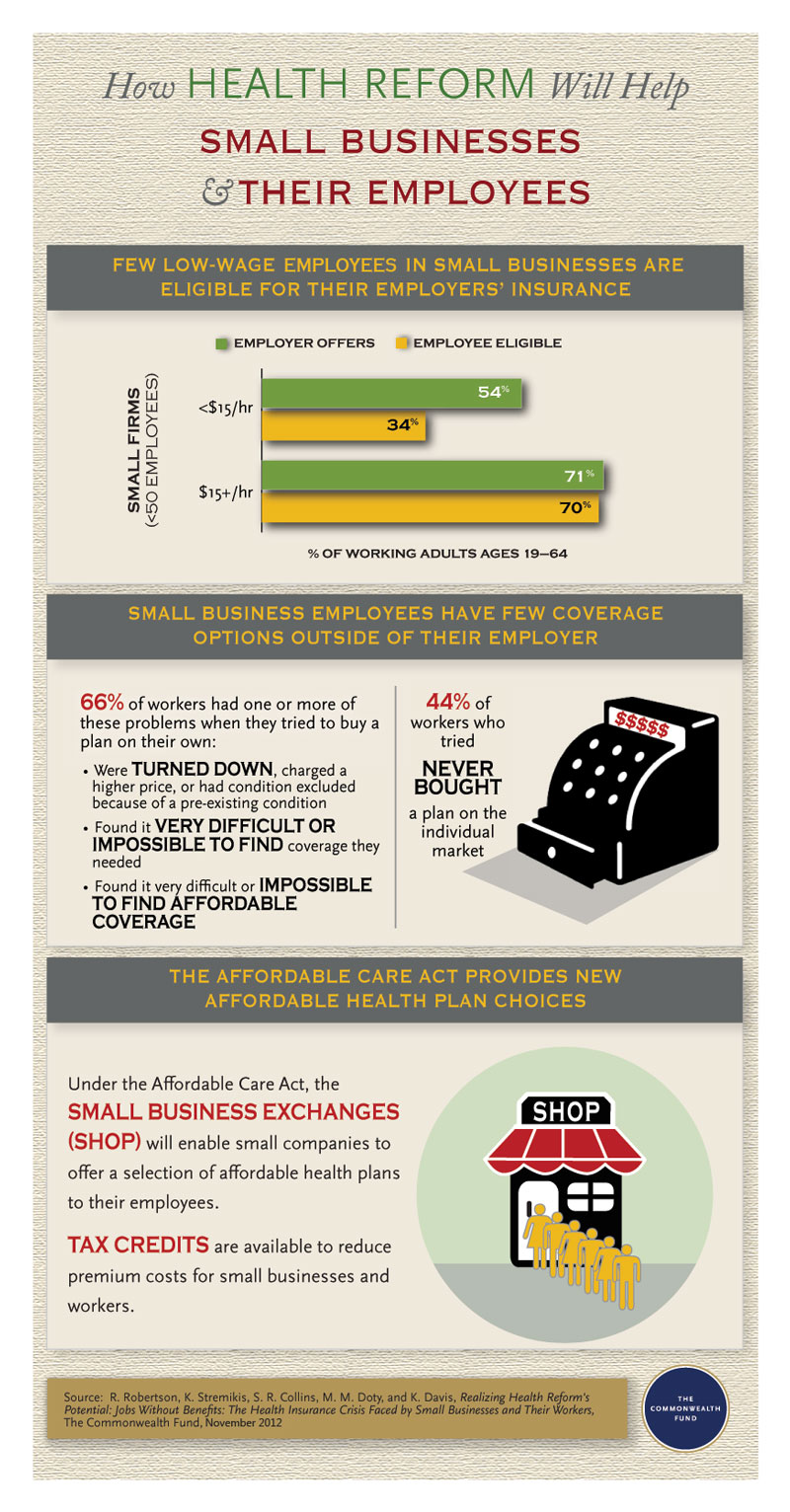
In the United States, employer-based health insurance is the primary source of health care coverage. In other words, our health care system lays the majority of the burden on business owners to provide Americans with health care. That is an enormous responsibility for business owners, but especially for those small businesses with 50 employees or less. A recent study by the Commonwealth Fund found the number of small businesses offering health insurance has dropped: in 2003, 58% of employees of small companies had employer-sponsored health care. Now fewer than half do.
I should know: I own a small business with my husband. When we looked into the cost of buying health care through our business we were astounded at the rates the various insurance companies quoted. We are a small business, three people, and none of us can afford to buy health care on the private market due to pre-existing conditions like asthma, chronic headaches, and of course, being a woman.
We desperately need health insurance and also want to show our appreciation and respect to our employees by offering them health care that they can afford without impossible premiums and deductibles that deter them from using it when they need it.
Not only do we feel it is our responsibility to provide health care but our employees are like family to us. We want them to be able to take care of their health. In addition, if our workers can get to the doctor for preventive care and various illnesses, they will be more productive at work with fewer sick days, which is good for our overall bottom line.
If you have ever been employed by a large company of say 100 employees or more, you were more than likely offered health care benefits at mostly affordable prices. In fact, 90% of workers in companies with 100 or more employees are offered and eligible for their employer’s health plans.
The stark difference between a large business and a small one is that small businesses are scraping to offer health insurance to employees or forced to leave their workers to find health care on the individual market. That is too expensive for many Texans, especially those with a chronic illness or pre-existing condition.
So what’s a small business to do? Well, in the past, there haven’t been many options. It was, “Sorry, you’re out of luck” to small business owners and employees, the backbone of the American economy. How unacceptable and insulting is that?
The Affordable Care Act offers a solution to this problem for small businesses. In January 2014, new provisions will help alleviate this financial burden and make health care a real option, one that’s affordable for both employers and workers. Small business owners will be have the option to participate in an exchange specifically for small businesses that will enable them to offer a variety of affordable health plans to their employees. Not only that, but the ACA allows for tax credits to ease any burden on the employer to reduce the costs on premiums for the small business owner and workers.
I am proud to say that when this exchange becomes available, my husband and I will be offering health care to our employees. We want healthy workers who are productive and know that they are valued and we also need it for ourselves. January 2014 cannot come soon enough!
By Courtney Watson, Children’s Defense Fund - Texas
A lot of discussion about the Affordable Care Act revolves around the role of health insurance exchanges. Texas will have one in 2014, but what is the health insurance exchange?
Our community educator, Cheasty Anderson, may be out on maternity leave, but she helped us in developing “video one-pagers” on key health care issues like this. We bring you a new one each Wednesday during our series. This week’s installment answers the question of how a health insurance exchange works.

