





Texan Sally Jo Hahn is self-employed and has a history of health concerns. Finding coverage on the private insurance market has been nearly impossible. Even the state’s high-risk pool, which would have cost thousands of dollars, kept her from joining for a time.
Under the Affordable Care Act Sally Jo’s choices—and those of many other Americans—will improve greatly.
Sally Jo of Austin Credit: Austin American-Statesman
Much of the American Dream is based on our country’s historic facilitation of self-made individuals who work hard to establish their own businesses and pave their own way. Our openness to self-started businesses is something that Americans are not only known for but intensely proud of.
Self-employment offers opportunity for unique entrepreneurship and the optimal utilization of individuals’ experience. It also serves as an avenue for increased job creation. But changing jobs—finding the right fit in a position that aligns with one’s interests—is another vital piece of any dynamic economy. People need to be able to go out and do what they’re made to do.
Today, however, Americans are often deterred from starting their own businesses or changing jobs, for fear of losing the security that comes with the job they have. Concern over being denied insurance coverage because of pre-existing conditions, being charged higher premiums, or losing access to a trusted provider keeps workers in “job lock,” continuing to work in jobs they would otherwise leave—in order to maintain health coverage.
As we’ve noted before, research from the Urban Institute and Georgetown University shows health care reform can help alleviate job lock and is likely to lead to 124,000 Texans striking out on their own. Beginning in 2014, no applicant for non-group coverage may be turned down for assessed risk or health status. All health insurance policies must provide a minimum level of coverage that includes 10 Essential Health Benefits, mandating coverage in areas such as maternity and newborn care, mental health, pediatric care, and general preventative, wellness services.
New reform under the ACA offers Texans and many other Americans the opportunity to venture out on their own and try something new. Workers will now feel more secure starting new endeavors that cater to their unique skillsets and experience, without the worry and concern that they cannot access quality, affordable health care for themselves and their families.
Written by: Hannah Guernsey, Children’s Defense Fund - Texas
If you’re an entrepreneur or small business owner, plan to become one, or work for one, there are 2 webinars (online presentations) coming up on March 12 and March 15 that WILL benefit you and your business.
The Texas Well and Healthy Campaign has partnered with the Small Business Majority to make these presentations available. Obviously, you’re already familiar with our grassroots Texas Well and Healthy campaign dedicated to ensuring access to quality, affordable health care for all Texans. For those who don’t know the Small Business Majority, it is a national non-profit group working to support America’s 28 million small businesses.
The 2 webinars will address what the new healthcare law — the Affordable Care Act — means for Texas small businesses. The presentations will focus on both federal and state provisions to help local small business owners understand how the law will affect them. Specific topics being discussed include:
- Small business tax credits — who is eligible and how to claim them
- Health insurance exchange: Texas update
- Shared responsibility
- Cost containment
- Tools and resources for small businesses interested in learning more about the law
A question and answer period will follow. We hope you will join us!
To register for March 12, click here || To register for March 15, click here
Editor’s Note: Both presentations will feature the same information, so there’s no need to register twice. Simply choose which date and time works for you!
The ACA makes it more affordable for businesses to offer health benefits to employees, including food-service workers.
Cross-posted from Children’s Defense Fund-Texas’ Business Leadership & Action project, a collaboration with Texas Well and Healthy to engage small businesses in understanding what’s in the ACA and moving successful implementation forward in Texas.
For this blog post, we’re shifting our focus briefly off of health care outreach to Small Businesses to highlight the lamentable practices of some influential conglomerates. Our Health Care Organizer, Courtney, recently got an e-mail from the organization SumOfUs – an online movement of consumers, workers and shareholders working to counterbalance the growing power of large corporations regarding one business in particular that still does not offer paid sick days to workers. The e-mail opened like this:
It’s flu season, but when you sit down in a restaurant, the last thing you want is a waiter with a cough carrying your breadsticks or a sous-chef with the flu…And yet if you’ve eaten at a Red Lobster or Olive Garden, there’s a good chance your food was prepared, handled, or served by a sick worker. Darden, the massive conglomerate that owns Olive Garden and Red Lobster, doesn’t offer its workers paid sick days, even though studies show that two-thirds of workers who don’t get to take paid sick days show up to work ill.
In addition to not offering paid sick leave, Darden has long ardently opposed the Affordable Care Act, which will soon require businesses to offer insurance to more employees. As the Huffington Post recently reported, Darden even tested shifting more employees to part-time so that the company wouldn’t be forced to provide health insurance.
However, due to backlash from the community, Darden has since recognized its error and retracted this failed test. This case is a PERFECT example of how we as citizens can decide enough is enough, organize and put an end to unjust practices when it comes to health benefits for workers, even when the odds seem too great.
But the struggle is not over. Many other businesses (not just Darden) continue to engage in practices we as consumers should not support.
As the e-mail goes on to state, “Darden can clearly afford to offer workers a better deal — it’s one of the most profitable restaurant chains in America.”
Practices like this impact so many different people—employees, their families, and all of us as customers, to name a few. The ability to call in sick and have other important health care benefits should be (and soon will be for many) accessible to all workers in businesses large and small.
Something we all have the power to do is to make the simple decision to support businesses that support the ACA and all of its protections.
Written by: Alyssa Haney, Children’s Defense Fund-Texas policy intern
Have you ever worked for a small business that didn’t offer you health care? Are you a small business owner who can’t afford to offer healthcare to your employees?
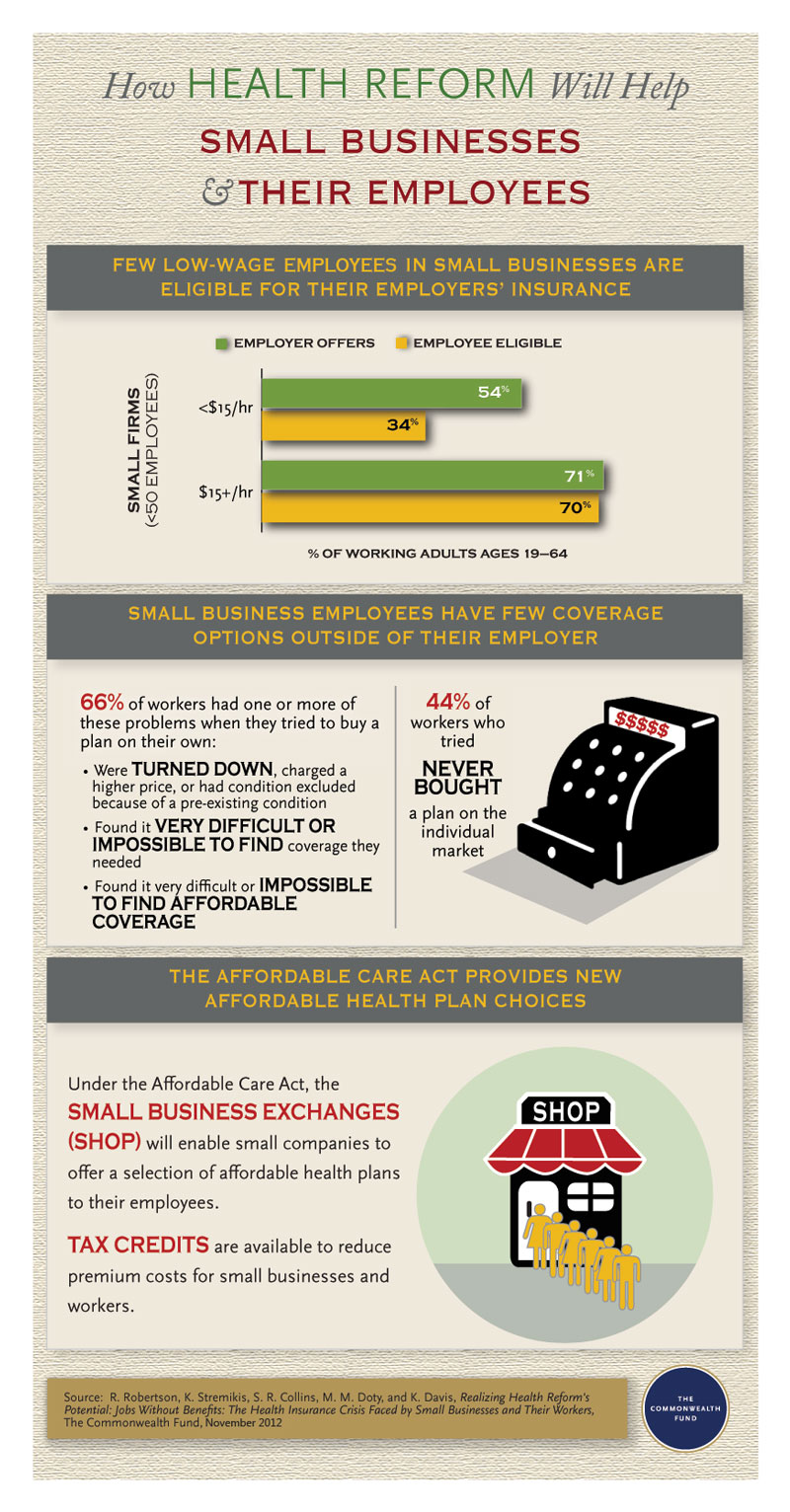
In the United States, employer-based health insurance is the primary source of health care coverage. In other words, our health care system lays the majority of the burden on business owners to provide Americans with health care. That is an enormous responsibility for business owners, but especially for those small businesses with 50 employees or less. A recent study by the Commonwealth Fund found the number of small businesses offering health insurance has dropped: in 2003, 58% of employees of small companies had employer-sponsored health care. Now fewer than half do.
I should know: I own a small business with my husband. When we looked into the cost of buying health care through our business we were astounded at the rates the various insurance companies quoted. We are a small business, three people, and none of us can afford to buy health care on the private market due to pre-existing conditions like asthma, chronic headaches, and of course, being a woman.
We desperately need health insurance and also want to show our appreciation and respect to our employees by offering them health care that they can afford without impossible premiums and deductibles that deter them from using it when they need it.
Not only do we feel it is our responsibility to provide health care but our employees are like family to us. We want them to be able to take care of their health. In addition, if our workers can get to the doctor for preventive care and various illnesses, they will be more productive at work with fewer sick days, which is good for our overall bottom line.
If you have ever been employed by a large company of say 100 employees or more, you were more than likely offered health care benefits at mostly affordable prices. In fact, 90% of workers in companies with 100 or more employees are offered and eligible for their employer’s health plans.
The stark difference between a large business and a small one is that small businesses are scraping to offer health insurance to employees or forced to leave their workers to find health care on the individual market. That is too expensive for many Texans, especially those with a chronic illness or pre-existing condition.
So what’s a small business to do? Well, in the past, there haven’t been many options. It was, “Sorry, you’re out of luck” to small business owners and employees, the backbone of the American economy. How unacceptable and insulting is that?
The Affordable Care Act offers a solution to this problem for small businesses. In January 2014, new provisions will help alleviate this financial burden and make health care a real option, one that’s affordable for both employers and workers. Small business owners will be have the option to participate in an exchange specifically for small businesses that will enable them to offer a variety of affordable health plans to their employees. Not only that, but the ACA allows for tax credits to ease any burden on the employer to reduce the costs on premiums for the small business owner and workers.
I am proud to say that when this exchange becomes available, my husband and I will be offering health care to our employees. We want healthy workers who are productive and know that they are valued and we also need it for ourselves. January 2014 cannot come soon enough!
By Courtney Watson, Children’s Defense Fund - Texas
Editor’s Note: The Texas Well and Healthy Campaign is proud to introduce you to the newest member of our team – Courtney Watson!
Courtney is an organizer with over 12 years experience and has worked with non-profits on community campaigns with a special focus on healthcare. Her goal for Texas Well and Healthy is to educate people about the Affordable Care Act and how it will impact small businesses in Texas.
As many of you know, small businesses account for the majority of the employers within the state of Texas and are a driving force behind our economy. In fact, there are more than 2.2 million small businesses in Texas, and small firms make up more than 98% of the state’s employers.
If you are connected with business groups or small business owners who want more details on how the ACA will affect small businesses in Texas and choices they have for better healthcare in Texas, let me know! You can email me at [email protected], or feel free to call at (512) 788-1301.
The majority of Texans work in small business or know someone who does. We must spread the word on how the ACA is creating affordable, quality healthcare for everyone!
Written by: Courtney Watson, Children’s Defense Fund - Texas
I’ve heard about the Affordable Care Act and how small businesses don’t have to provide insurance, but large employers do have to, or they’ll pay a penalty. I run a business with 16 full-time office employees (whom we insure) and over 250 part-time employees (who don’t get insurance), and I’m curious whether that means I’m a small or large employer. I heard you speak at a presentation last week and you said that it would be based on FTE’s. Also, I’d like to know the effect on part-time employees. Will I have to provide insurance for all of my employees? I would love to know the answer when you get a chance.
Thanks,
Trying to Get My Ducks in a Row
Dear Ducks,
I take my hat off to you for doing your best to understand one of the more complicated aspects of the Affordable Care Act – determining whether large employers have to pay a penalty if they don’t insure their full-time employees. OK, first let’s sketch out the broad regulations, and then I’ll talk about your case in particular.
Starting in 2014, the ACA essentially requires large employers to provide full-time employees with affordable health coverage. Small employers (fewer than 50 employees) have no obligation to provide insurance, will face no penalties if they do not, and may even qualify for tax credits to help them afford coverage.
The difference between a small employer (no obligation to provide insurance) and a large employer (obligation to provide insurance) hinges on the magic number 50. Fifty FTEs (full-time equivalent positions – keep in mind that the limit for “full time” in the ACA is 30 hours a week) is the line between small and large. In other words, if you have 51 or more FTE employees, you are a large employer, and therefore required to provide insurance to all full-time employees (only those employees who work 30 hours a week or more, on average).
So here’s where the penalty comes into play. If you choose not to provide insurance for your employees, and any of your full-time workers get subsidized health coverage in the exchange (relatively likely if you are a large employer that doesn’t provide insurance), you will pay the tax penalty. That tax penalty is $2,000 a year for your total number of full-time employees minus 30. In other words, if you have 70 full-time employees and choose not to insure them, you’ll pay $2,000 a year on each of those 40 employees (broken into 12 monthly payments).
Confused yet? Great! Let’s keep going.
Let’s say that you DO provide health insurance, but it’s not very good insurance. If the insurance you provide either (a) costs the employee more than 9.5% of his/her household income, or (b) offers exceptionally poor coverage (e.g., it fails to cover at least 60% of the cost of covered benefits, on average) then those employees may seek out and qualify for subsidized health insurance on the Health Insurance Exchange. If any of your employees does that, then we go through another set of questions.
Ready for the next set of qualifiers and if/then statements? OK! Let’s say that you offer your employees an expensive health insurance plan, or one with poor benefits. If one or more of your employees qualifies for subsidies and enrolls in an Exchange plan, you will have to pay the shared responsibility penalty.
But this penalty may be less than the flat fee assessed at the “I don’t offer insurance at all” level, described earlier. Instead, here you’d pay the lower of the following two amounts: EITHER $2,000 a year for each full-time employee (minus the first 30), OR $3,000 a year for just the number of full time employees who receive government subsidies for insurance on the Health Insurance Exchange.
OK, how are you doing, Ducks. Still with me? You are? Wow, I’m impressed. This is dizzying stuff! OK, now let’s look at your scenario.
You employ 16 full-time and 275 part-time employees. By any calculation, you, Ducks, are a large employer and would be obligated to provide insurance for all full-time employees (30+ hours/week). But I’m not sure how many hours a week your part-time staff work, so I’ll just assume that each part-timer works an average of 20 hours a week.
You already provide insurance (and you’re probably a good boss, so I’ll assume it’s fairly decent insurance) for your 16 employees, so none of them will qualify for or seek out subsidized coverage on the Exchange. You are only obligated to insure those employees that work 30 hours a week or more (on average), so chances are good that you are all ready for full ACA implementation in 2014, Ducks. You will not have to offer coverage to previously uncovered employees, and you won’t have to pay a penalty because you are already providing insurance to your full-time (remember: 30+ hours a week!) staff.
If you (or anybody out there) have more questions about their status relative to insuring employees, feel free to write me, but I also recommend you consult with your tax guy or an attorney who understands the regulations, just to make sure all relevant details get taken into consideration.
To a well and healthy Texas,
Cheasty Anderson
More questions for Cheasty? Email them to [email protected]
I have always aimed to work for a large company. This was as much to maximize my career potential as it was in finding a good paying job. I was taught by my father to look at the intangibles when negotiating compensation, not the least of which was health insurance benefits.
When I was diagnosed with diabetes shortly before graduating from college, I was still in a sweet spot for coverage – I could still stay on my parents’ insurance. It wouldn’t be long before I found out how hard it can be to buy a health insurance policy on my own with a pre-existing condition.
As a new business school graduate, I lucked out and found an employer that offered health care coverage, a small business that was generous enough to pay 100% of the premium cost. I found out quickly how rare this sort of thing is. This small business quickly found out that in tough economic times, they needed to cut back expenses. Rather than lay off employees, they chose to cut health benefits. This is an all too common situation.
Coincidentally, another opportunity came up and I left that company shortly after those changes. The opportunity came through a very large global high tech company, which, along with more stability, offered better health care benefits at a more affordable cost to the employer and employee.
I was glad for these benefits but I still couldn’t shake the nagging question of Why? Why was it ok for health insurance companies to negotiate better rates and lower premium costs for large companies but not small ones?
During the period between leaving my small company job and starting my large global corporation job, I did some research on what it would cost to buy health insurance on my own. I applied with four different major health insurance providers and was automatically turned down by three. The fourth provider offered me a policy to the tune of $1,700 per month. I felt tremendous relief that I was headed into a job where I knew I could get affordable coverage.
But this is still not the case for many, many Texans. According to the Center for Public Policy Priorities, more than 67% of all businesses in Texas are small businesses (considered companies with fewer than 25 employees). The cost to provide health insurance is still astronomical. And what of the thousands of self-employed men and women in this state? How do they even obtain health insurance if they or their spouses or their children have a pre-existing condition? Sadly, they don’t. These families balance on the precarious edge between health and catastrophe.
There is good news, though.
The Affordable Care Act is making it possible and more affordable for individuals and small businesses to purchase insurance. Since 2010 children can’t be excluded from individual health insurance coverage because of pre-existing conditions, and this will be true for adults in 2014. Small businesses can also receive up to a 35% tax credit for providing health insurance for their employees.
But the news gets better.
In 2014, no eligible person will be able to be turned down for health insurance coverage or up-charged based on health history. Tax credits will be increased to up to 50% for small businesses that provide health insurance to their employees.
I think we’re moving in the right direction and we’re taking the right first steps in creating a health care system that is accessible and affordable for all Americans.
Contributed by: Gloria Litt, Austin, Texas.
 Dear Cheasty,
I am the owner of a small business that employs 75 people. Our company provides access to health, dental, vision, life, LTD, ADD, and optional insurance. The company pays the first $300 of the full premium, which represents up to an 80% contribution rate on the employer side.
During a recent talk I heard you give, you said that insurance companies are barred from increasing rates more than 9.9%. Yet this year,our particular group rates increased 20%. In order to keep the premiums low, we opted for “poorer” plans that have higher deductibles, higher co-pays, higher out of pocket minimums, but our employees still have to pay more in premiums. Under the plans that we chose, the lowest cost plan for a family with a $6000 deductible, 70% co-insurance, $10,000 maximum out of pocket, and $45 doctor visit co-pay, is $955 per month. That is about 35% of our average non-management take-home salary. That is too much! As a result, many of our employees do not cover their children or spouses. So, although they have access to health insurance, it is prohibitively expensive. “A dream deferred is a dream denied.”
If the maximum rate increase is 9.9%, how can they charge us so much more than that? Should I contact the Texas Department of Insurance, or the Office of Public Insurance Counsel?
I really support a “government takeover” of healthcare – I wish that making these hard decisions were out of the hands of employers. I think it would give us a level playing field as we compete for qualified employees with larger businesses. (I lost a computer programmer last month in a bidding war with BP — I can’t offer the deep discounts on health insurance benefits that they have the luxury of).
Sincerely,
Frustrated Business Owner
Dear Frustrated,
I am so sorry to hear that you are having so much trouble finding accessible and affordable health insurance for your employees. Sadly, yours is a story I hear far too frequently. You’ve asked some really good questions, and the answers break down into two categories: good news and bad news. I’m going to give you the bad news first, and then end on a couple of high notes.
OK, first for the 9.9% cap on yearly insurance rate hikes. Insurers are not, as you thought I said, banned from raising them more than 9.9% (I’m sorry if I was unclear). What the Affordable Care Act does is guarantee that if the rate hike is 10% or higher, then it triggers an automatic review process. That is, the Texas Department of Insurance (TDI) must conduct a review to figure out whether that rate hike was fair and justified or not. (For Texas, the sad news here is that, unlike in some other states, TDI can’t tell a company not to raise the rate that high, they can only recommend that it not be raised that high. We’ll be fighting to give the TDI enforcement power this coming legislative session, so stay tuned!)
One more important thing to understand is that the 9.9% cap is not a cap on the policy offered to one person or business. Rather, it is a limit on the company’s average increase across a group. So if your policies went up 20%, they have to balance out their average by not raising somebody else’s rates.
What are the reasons an insurance company may “justifiably” raise rates? There are six categories: health, gender, age, geography, type of work, and size of group. Therefore, if somebody on your plan recently battled cancer, the “health” category would raise a red flag for your insurer. If you lost seven male employees and hired seven female employees in their place, your “gender” category would light up, because insurance companies charge more to cover women than men. If a few of your employees aged into a higher age category, your rates would go up because they charge higher rates for older folks. As you can see, there are lots of reasons why RIGHT NOW, insurance companies can raise rates like they just did to you.
So that was the depressing reality. Now for some good news. When the ACA goes into full effect on January 1, 2014, insurance companies will lose some of those six categories that they use to “adjust” rates for their clients. They won’t be able to charge women more than men. They won’t be able to charge a company more based on the type of work that they do. And most importantly, they won’t be able to raise rates or deny coverage based on health history or condition. So no more rate hikes based on an employee getting sick. Depending on the reasons for which your insurer raised your rates, these provisions may stop your group policy from rising so quickly or so high.
But best of all, Frustrated, if you still can’t afford the health plans for your employees, you can simply stop providing insurance without being a “bad employer.” Here’s how it could work. As a “large business” owner (i.e. larger than 50 employees) you will have to pay a fee of approximately $2000 a year for every employee that you don’t insure (there are caveats, of course, too much detail for a blog post, but you can click here to read all about the ACA provisions for large businesses). You’ll get the first 30 employees free, so if you have 75 employees, you’ll have to pay the fee for 45 employees. That’s a total of $90,000 a year in fees [$2,000 x 45 = $90,000]. Right now, if my math is correct, you pay $270,000 a year for insurance [12 months x $300/month x 75 employees = $270,000].
In short, Frustrated, you could cancel your insurance, pay the fees and pay your employees several hundred a month toward buying their own insurance, which they’ll be able to do – with government subsidies! – on the Health Insurance Exchange, which will begin operating in 2014.
I know there are so many questions still left unanswered, Frustrated, and I hope this answer goes a long way toward helping you understand what is going on with your insurance rates. If you still have questions for me, feel free to email me at [email protected] and I’ll be happy to answer in more depth!
To a well and healthy Texas,
Cheasty Anderson
I have always aimed to work for a large company. This was as much to maximize my career potential as it was to find a good-paying job. I was taught by my father to look at the intangibles when negotiating compensation, not the least of which was health insurance benefits.
When I was diagnosed with diabetes shortly before graduating from college, I was still in a sweet spot for coverage – I could still stay on my parents’ insurance. It wouldn’t be long before I found out how hard it can be to buy a health insurance policy on my own with a pre-existing condition.
As a new business school graduate, I lucked out and found an employer that offered health care coverage, a small business that was generous enough to pay 100% of the premium cost. I found out quickly how rare this sort of thing is.
This small business quickly found out that in tough economic times, they needed to cut back. Rather than lay off employees, they chose to cut health benefits. This is an all too common situation.
Coincidentally, another opportunity came up and I left that company shortly after those changes. The opportunity came through a very large global high-tech company, which, along with more stability, offered better health care benefits at a more affordable cost to the employer and employee.
I was glad for these benefits but I still couldn’t shake the nagging question of Why? Why was it OK for health insurance companies to negotiate better rates and lower premium costs for large companies but not small ones?
During the period between leaving my small-company job and starting my global-corporation job, I did some research on what it would cost to buy health insurance on my own. I applied with four different major health insurance providers and was automatically turned down by three. The fourth provider offered me a policy to the tune of $1,700 per month. I felt tremendous relief that I was headed into a job where I knew I could get affordable coverage.
But this is still not the case for many, many Texans. According to the Center for Public Policy Priorities, more than 67% of all businesses in Texas are small businesses (considered companies with fewer than 25 employees). The cost to provide health insurance is still astronomical. And what of the thousands of self-employed men and women in this state? How do they even obtain health insurance if they or their spouses have a pre-existing condition? Sadly, they don’t (though there is an option now for their children with pre-existing conditions, thanks to the Affordable Care Act). Too many families balance on the precarious edge between health and catastrophe.
There is good news, though. The Affordable Care Act is making it possible and more affordable for individuals and small businesses to purchase insurance. As I mentioned, since 2010 children can’t be excluded from individual health insurance coverage because of pre-existing conditions, and this will be true for adults in 2014. Small businesses can also receive up to a 35% tax credit for providing health insurance for their employees.
But the news gets better. In 2014, no eligible person will be able to be turned down for health insurance coverage or up-charged based on health history. Tax credits will be increased to up to 50% for small businesses that provide health insurance to their employees.
I think we’re moving in the right direction and we’re taking the right first steps in creating a health care system that is accessible and affordable for all Americans.
Gloria Litt, guest blogger for Texas Well and Healthy, writes regularly about her experiences at http://mamatejana.wordpress.com.

